
You ask, "How was school?" and you get, "Fine."
You try "What did you do today?" and the answer is "nothing."
You know there's a whole world inside your child's head, thoughts, worries, funny observations, things they're quietly figuring out, and somehow a one-word answer is all you can access.
This is one of the most common things parents say. Not because they're bad at connecting with their kids, but because open-ended conversation is genuinely hard to initiate, especially when kids are tired, distracted, or at an age where talking to a parent feels awkward by default.
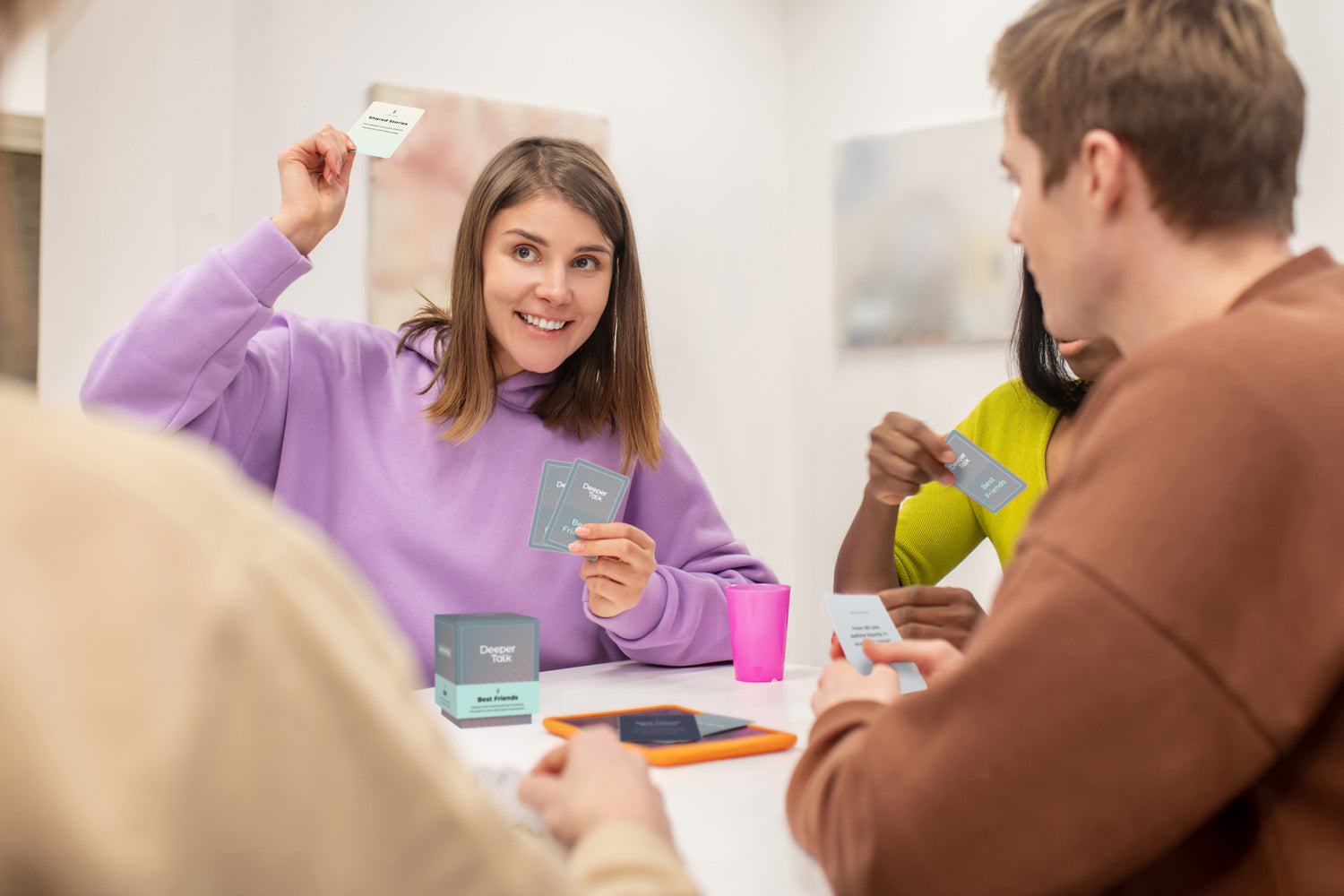
Conversation cards for kids are a practical solution to exactly this, and when they're done well, they change the whole energy of family time.
Conversation cards for kids are structured question prompts designed to help parents and children have richer, more genuine conversations. This guide explains why they work, what makes a good set, how to use them without feeling forced, and includes 30 sample questions you can try tonight, from funny and light to thoughtfully deeper.
Why "How Was School?" Doesn't Work (and What Does)
The problem with most parent-child conversation starters isn't effort; it's question type.
"How was school?" is what psychologists call a closed question: it has a natural one-word endpoint. The child answers it accurately ("fine"), the conversation closes, and everyone goes back to what they were doing. Nobody's fault. The question just doesn't create space.
Research in developmental psychology consistently shows that children are significantly more communicative and more honest in response to open-ended questions that invite elaboration rather than completion. Questions like "what was the most surprising thing that happened today?" or "if you could change one thing about school, what would it be?" can't be answered with "fine." They require the child to actually think, and in thinking, they talk.
This is the core logic behind conversation cards for kids. They replace closed questions with open ones structured in a way that removes the "where do I even start" problem for parents, and removes the pressure-to-perform feeling for children.
The best kids conversation cards also do something else: they make the whole thing feel like a game, not an interview. And that framing change from "parent asking questions" to "we're playing something together" is often what makes the difference between a child opening up and a child going quiet.
What Makes a Good Set of Conversation Cards for Kids?
Not all kids' question cards are equal. Here's what separates the ones that actually work from the ones that get used twice and end up in a drawer:
Age-appropriate depth levels
A question that works brilliantly for a ten-year-old will confuse a five-year-old and bore a teenager. Good conversation cards for children are organized by age range or depth level so the questions actually land for the child in front of you, not a theoretical average child.
DeeperTalk's Kids Game does this through progressive depth levels: Level 1 questions are light, fun, and accessible for younger children; later levels go deeper in ways that are appropriate for older kids and teens. It's the same card game across a wide age range, which means it grows with your family.
Questions that go both ways
The best kids' conversation cards create a two-way conversation, not a one-way interview. When a question invites both the parent and the child to answer, the whole dynamic shifts. Kids are far more likely to be honest and open when they see a parent being honest and open first.
A mix of fun and meaningful
A deck that's only "deep and meaningful" will feel heavy to a seven-year-old. A deck that's only silly won't give you the moments you're actually hoping for. The right balance between funny warm-ups leading into more genuine questions lets the conversation find its own depth naturally.
Activities, not just questions
Some of the most connecting moments in family life aren't verbal; they're doing something alongside each other. Good kids conversation cards include activity prompts as well as questions: "draw something together," "take turns saying one thing you love about each other," "act out your favorite animal." These work especially well for younger children and kids who are less verbally expressive.
30 Conversation Card Questions for Kids (Organized by Depth)
These are the kind of questions good conversation cards for kids are built around. Try a few tonight and see where they go.
For Younger Kids (Ages 5–8)
-
If you could have any animal as a pet, what would it be and what would you name it?
-
What's your favorite thing we do together as a family?
-
If you could eat one food for every meal, what would you pick?
-
What makes you feel really brave?
-
If you had a magic power, what would it be and who would you help first?
-
What's the funniest thing that happened to you this week?
-
What do you wish you were really, really good at?
-
If you could go anywhere in the whole world, where would you go?
For Kids Ages 8–12
-
What's something that made you laugh so hard this week?
-
Is there something at school that's been hard lately that you haven't talked about?
-
What do you think makes someone a really good friend?
-
What's something you're looking forward to this week?
-
If you could change one rule at school, what would it be?
-
What's something you learned recently that surprised you?
-
What do you think is the most important thing in life? (Yes, really kids have opinions on this.)
-
If you could spend an entire day doing anything you wanted, what would it look like?
-
Is there something you've been worrying about that I might be able to help with?
-
What's something you think you're better at than most people your age?
For Tweens and Teens (Ages 12+)
-
What's something about yourself you've figured out this year?
-
Is there a person in your life who really gets you and what makes them different?
-
What's something you believe that most people your age don't seem to?
-
What part of the future are you most excited about and what part do you think about nervously?
-
What's something you wish adults understood better about being your age?
-
Is there anything you've wanted to talk to me about but didn't know how to bring up?
-
What's a goal you have that you haven't told many people about?
-
What do you think makes a family actually work well?
-
Is there anything about yourself you've been trying to change?
-
What's something I do that you really appreciate, even if you don't always say it?
For the Whole Family (Any Age)
-
If our family had a theme song, what would it be and why?
-
What's one thing you want to do together as a family before the end of the year?
How to Use Conversation Cards with Kids Without It Feeling Forced
The most common mistake parents make with kids' conversation cards is making the activity feel like an activity.
If you announce "okay, we're going to do conversation cards now" at the dinner table, most kids, especially older ones will immediately sense that something intentional is happening, and the walls go up. Younger kids might be fine with it, but tweens and teens tend to become performatively reluctant.
Here's what actually works:
1. Build it into an existing routine. Dinner is the obvious one, but the car is actually better for many families, especially with older kids. There's no eye contact pressure, you're both already stuck there, and the low-stakes environment makes openness easier. Road trips and school pick-ups are gold.
2. Make it genuinely two-way. Before you ask your child a question, answer it yourself. Don't just model and actually share something real. When kids see a parent being vulnerable or funny, or honest, it gives them permission to do the same.
3. Start lighter than you think you need to. Even if you're hoping to eventually get to the deeper questions, start with the fun ones. A child who's been laughing for five minutes is much more open than one who was just handed a "serious question."
4. Follow the interesting answer, not the next card. If your child says something unexpected or surprising, put the cards down and follow that thread. The card was just the door. The conversation behind it is what matters.
5. Keep it short and low-pressure. Three or four questions done well is better than running through fifteen. No child should feel like they're being debriefed. Stop while it's still fun.
If you want a deck that does all of this thinking for you with 300+ questions and activities built specifically for kids across progressive depth levels, co-created with child psychologists and family therapists, the Kids Game was designed exactly for this. It's not a generic family card game; it's a structured tool that understands how children actually open up.
The Real Reason Parents Search for Conversation Cards for Kids
It's worth naming this directly: most parents who search for conversation cards for kids aren't searching because things are bad. They're searching because they sense something is slipping that their child is growing up faster than their conversations are growing with them.
The nine-year-old who used to tell you everything is now giving you one-word answers. The teenager who used to want your opinion now acts like your opinion is the last thing they need. It doesn't mean the relationship is broken. It means the old approach stopped working, and you need a new one.
A good set of conversation cards for kids isn't a fix. It's a bridge. It gives both of you a reason to be in the same conversational space, at the same depth, without either of you having to do the awkward work of getting there alone.
Research in child development including studies on parent-child communication by the Search Institute consistently shows that regular, open conversation between parents and children is one of the strongest predictors of long-term child wellbeing, emotional resilience, and trust in the parent relationship. The conversations don't have to be heavy. They just have to happen.
Explore more ideas in our guide to family bonding activities or browse conversation starters for families for more question ideas across all ages.
Key Takeaways
-
"How was school?" fails because it's a closed question with a natural one-word endpoint. Open-ended questions work because they create space, not just ask for information
-
Good conversation cards for kids are age-appropriate, go both ways, mix fun with meaning, and include activities alongside questions
-
The setting matters as much as the question. Car, mealtimes, and low-pressure routines work better than announced "let's do conversation cards" sessions
-
Starting lighter, answering first, and following interesting threads are the practical habits that make conversation cards actually work
-
Regular open conversation between parents and children is one of the strongest predictors of long-term child wellbeing; the content matters less than the consistency
FAQ
What are conversation cards for kids?
Conversation cards for kids are structured questions and activity prompts designed to help parents and children have richer, more open conversations. They replace closed questions like "how was school?" with open-ended prompts that kids can't answer in one word, making conversation feel natural rather than forced.
At what age are conversation cards appropriate for?
Good conversation cards cover a wide range, typically ages 4 or 5 through to teenagers, with depth levels organized by age group. Younger children respond well to imaginative and playful questions; tweens and teens need questions that respect their growing autonomy and self-awareness. Look for decks with progressive depth levels rather than a one-size-fits-all approach.
Do conversation cards for kids actually work?
Yes, when used consistently and in the right setting. The key is that good conversation cards replace closed questions with open ones, make the interaction feel like a game rather than an interview, and are used in low-pressure environments like the car or dinner table. They work best when parents answer the questions too, not just children.
What are good deep questions for kids?
Good, deep questions for kids are age-appropriate and open-ended. For younger children: "What makes you feel really brave?" For older kids: "Is there something at school that's been hard lately that you haven't talked about?" For teens: "What's something you wish adults understood better about being your age?" The question should invite reflection without feeling like a test.
What's the difference between conversation cards for kids and regular question cards?
Kids' conversation cards are specifically designed for the parent-child dynamic with age-appropriate language, a mix of fun and meaningful questions, and often activity prompts as well as verbal questions. Generic question card games aren't built around how children actually communicate, which means they tend to fall flat quickly.
How do you use conversation cards with kids without it feeling awkward?
Build them into an existing routine rather than making them a separate activity. The car, dinnertime, and bedtime wind-down all work well. Answer questions yourself before asking your child. Start with the lighter, funnier questions first. Follow interesting answers instead of moving straight to the next card. Keep sessions short: three or four questions done well beats a full deck done mechanically.
If you want a beautifully designed, psychologist-backed version of this for your family, the Kids Game has 300+ questions and activities across six progressive depth levels, built specifically for children. It works across a wide age range, grows with your family, and feels like a game, not a session. New customers get 15% off with code FIRST15 at deepertalk.com.